← Back to Resources & Archives
By Bonnie S. Dannenberg · Marshfield · December 2008
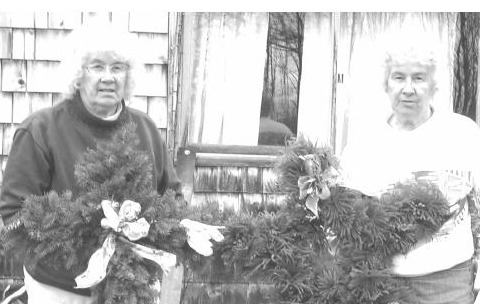
Elizabeth Brown remembers when she and her twin sister, Katherine Vaillancourt, started making Christmas wreaths in 1950. She said they “… used to bring the brush out of the woods with a horse and wagon,” in those early years. Later they used a tractor. If they cut brush on someone else’s land, the farmer who owned it would often bring it out of the woods for them, either as a favor, or as “part of the deal.” Katherine added, “You need to cut your own brush to make a wreath. It won’t work for you if someone else cuts it.”
The twins grew up in Cabot. They married brothers, Bob and Leo Brown, one Christmas Eve in the late 1940s. Except for fifteen years, when Katherine lived in Woodstock, they’ve both lived in Marshfield ever since. Katherine didn’t make wreaths while in Woodstock, but Elizabeth said she’s “never taken a break from it.”
In addition to making and selling wreaths, the two families began to sell Christmas trees about 1950. Since 1951 or 1952, they’ve also sold brush to other wreath makers. They remembered cutting fourteen tons of brush one year. Now that they are 78 years old, they said they only can cut brush for about an hour and a half at a time.
Today, we associate wreaths with Christmas, but they predate Christianity. We connect wreaths with the Greek god Apollo, who represented life and health. Ancient Greeks used laurel wreaths as crowns of victory at the Pythian Games, a forerunner of today’s Olympics. Roman military heroes wore wreaths made from olive branches in parades. Aristocrats added jewels and precious metals to create crowns.
Our word wreath is from an old English word, writhen, meaning to writhe or twist. The twins learned to twist brush into wreaths from a North Danville man. Decades ago, half a dozen Brown family members worked from October to December to make 500 wreaths every season. The pay was $5 a dozen for their labor; buyers supplied rings and brush. Now the twins make 100 to 150 of their own wreaths a year.
It’s hard to know when it’s time to gather the brush. Katherine said, “You can’t collect it when it’s warm, because the needles will fall off. You have to wait for a hard frost or a snowstorm. Usually that happens about late October.”
Elizabeth added you need a very good pair of clippers. She fondly recalled a really good pair she used for years. They cost her $35, but she said, “They paid for themselves many times over.”
The twins buy the metal rings, star and cross forms, wire, some decorations and ribbon. Because some folks like to decorate their own wreaths, they sell about half of their wreaths undecorated.
All wreath makers have their own styles. After 58 years of making wreaths, they still give each other pointers as they work. The twins use fir for cross or circle wreaths and princess pine for the stars. Princess pine, actually a club moss, although beautiful, is not easy to find. Gathering it is hard on your back, they said.
For modern Christians, a circular wreath, without beginning or end, symbolizes God’s eternity and mercy during Christmas season. Evergreen branches stand for God’s everlasting love; the color green represents hope and new life. But that wasn’t always true. In the early third century, the theologian Tertullian complained that more Christians than pagans decorated their doors with laurel wreaths.
Advent wreaths originated as folk traditions of the people of northern Europe. In deep winter, candles were lit on circular shaped bundles of evergreens. The candle-light gave the people comfort at that darkest time of the year, as they looked forward to the warm days of spring. Evergreen wreaths are also placed on graves, or floated on the sea, to remember the dead.
The twins remembered their own family Christmas Day traditions. First they spent time with their father-in-law, Henry Brown; then drove to Cabot to be with their father, Joe Joyal. Finally, they went home to exchange their own gifts and have Christmas dinner with their eleven children. Cash for Christmas presents and their children’s winter clothes came from selling wreaths.
If you’d like a locally-made holiday wreath for your home, the twins are open for business until December 10. You can phone Elizabeth Brown at 426-3862 or Katherine Vaillancourt at 426-3509.
Reprinted with permission from the Cabot Chronicle, December 2008.