The first Cabot settlers cleared land on Cabot Plains. For about 15 years, town business was conducted there. At the geographic center of the six mile square township, about two miles south of the Plains, a second community formed, the Center. James Morse, Esq. built the first log home there, in 1789, followed by Oliver Walbridge.
In 1790, Major Lyman Hitchcock, Captain Jesse Leavenworth and Asa Douglas, Esq., gave eight acres to the town, for public use. Four acres were cleared, for a common and a schoolhouse. In 1796, the stocks and whipping post were moved, from the Plains, to the Center, despite protests from Plains residents. Thereafter, town meetings and public gatherings were at the Center. The town built a pound for stray livestock there. A store, started by Luther Wheatley, was later run by Hector McLean. The 1800 census counted 349 residents throughout the growing Town of Cabot.
Gradually, attracted by water power, people moved downhill, alongside the Winooski River. By 1849, as happened on the Plains, the newer Cabot Village settlement grew and the Center faded.
All that remains of the Center is Cabot's first public cemetery, on land donated by William Osgood, in 1799, and signs that mark former locations of the whipping post and meeting house.
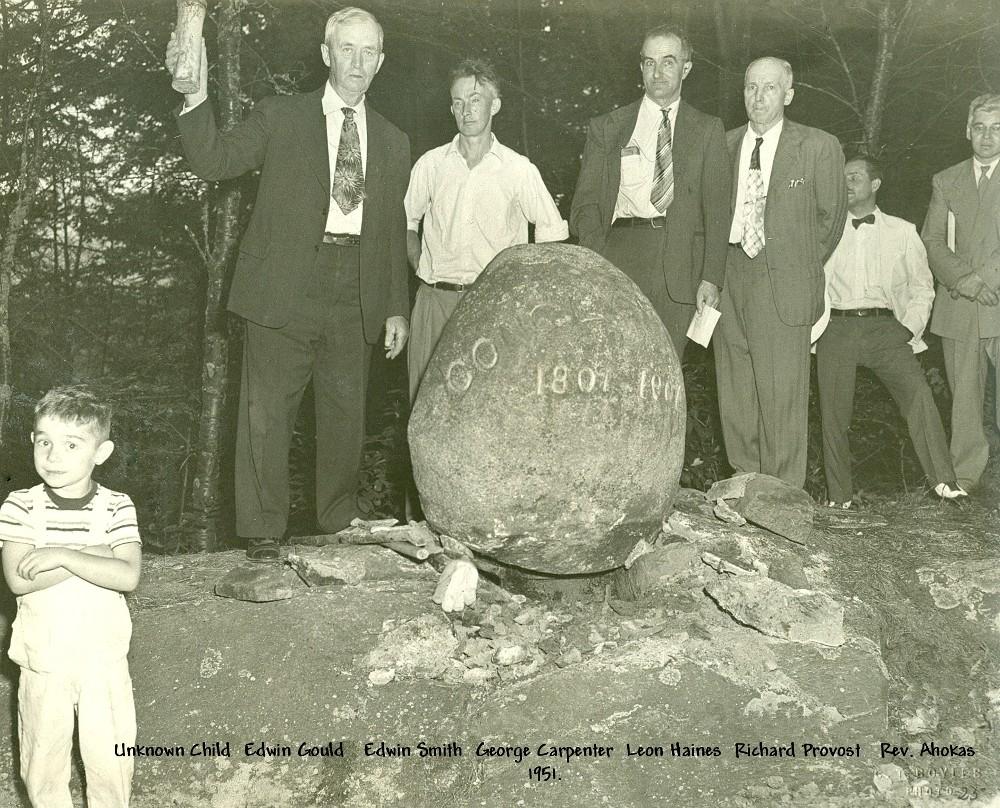
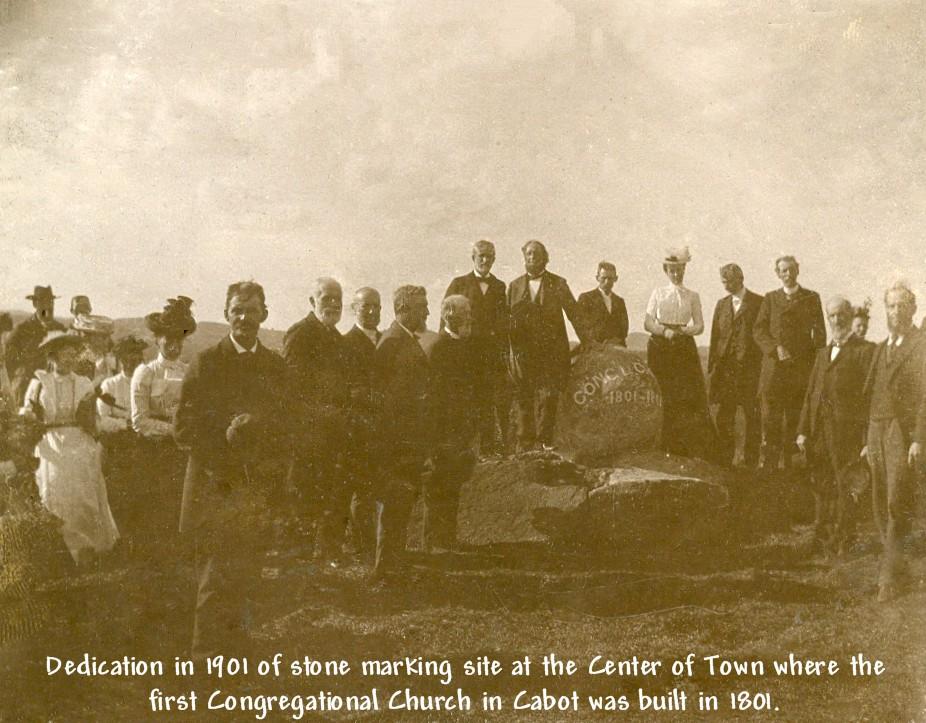
A boulder, with a plaque that memorializes the first site of the Congregational Meeting House, was moved to the lawn of Cabot Historical Society's Main Street Museum, by the Cabot Highway Department, in 2021. It was marred with paint in the deserted Center.
There is still evidence of the stray animal pound, a square indentation in the earth, with crumbling rocks that once enclosed it. Most large trees in the Center were felled to clear land for farming. Today, where the church, stocks and Center Common stood are tall pines.
The cemetery, a few rods west and downhill from the old Common, was nearly lost. Several Revolutionary War veterans are among Cabot pioneers interred there. In WWI, when the government paid subsidies to raise crops, someone removed fragile field-stone grave markers, to plant potatoes. There was outrage. Stones were replaced, but likely not in their original locations. Several were lost.
The Center Cemetery was untended for years. In 1992, Ruth and Glen Goodrich of Cabot, with a group from the Church of Jesus Christ of Latter-Day Saints, joined several Cabot citizens, to clear trees and brush. The next spring, Sexton Velma Smith, Road Commissioner Allan Perry, a few town employees, and many volunteers, including the Cabot High School Heritage Class, under teacher David Book, cleaned and repaired headstones, pulled stumps and sowed grass. A narrow unpaved road leads to restored Center Cemetery.
from HISTORIC RESOURCES Cabot Town Plan, 2017:
"The Center Cemetery, Pound, and Markers - Cabot Center, located in the geographic center of Town, was the main settlement in Town prior to the mid-1820s, when the area which is the present village center gained prominence. The Center Cemetery, located on Old Center Road, contains the oldest gravestones in Cabot, including many of the first settlers. About 1915, the stones were removed and the ground was ploughed and planted with potatoes. The stones were later replaced and set in rows.
The Center Pound, where stray animals were confined in early settlement days, was rebuilt about 1915. The former location of the first Congregational Church in Cabot is marked by a large boulder bearing an inscription. (The church building was moved to the village in 1826.)
The last time capsule, and the unused cylinder intended to replace it, are in the Main Street Museum.