A creamery has stood in Cabot village since 1893, and for more than a century it has belonged to the farmers who ship their milk to it. What began as a small butter plant at the headwaters of the Winooski became the Cabot Farmers' Co-operative Creamery, and later the Cabot brand sold across the country. This page follows that history from the first stock company of 1893 to the merger with Agri-Mark in 1992.
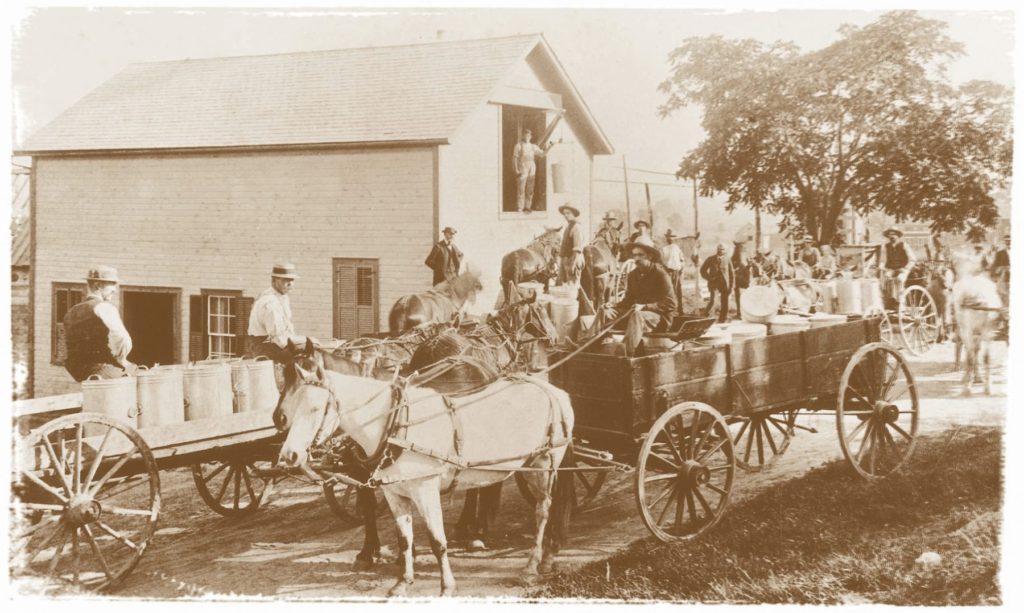
The first creamery, 1893
Through most of the 1800s, Vermont dairy farms made their own butter. Skimming, churning and working the butter was daily labor, most of it done by farm wives, and each farm then had to find its own buyer. Cream cabinets and, in 1890, the mechanical cream separator — built in Vermont by the Vermont Farm Machine Company of Bellows Falls — made it practical to gather many farms' milk in one place and process it together. Central creameries spread quickly; by 1915 Vermont had nearly three hundred.
Cabot farmers took up the idea early. In February 1893 they organized a stock company, raised $3,000, and pledged about six hundred cows. The officers were Luke C. Fisher, president; Hiram Wells, clerk; and T. H. Lance, treasurer. The shareholders chose the Buchanan lot in the village as the site and hired Mosley & Stoddard of Rutland to build and equip the plant for $2,720.
The Cabot Creamery Company opened on Monday, June 19, 1893. The Vermont Watchman followed it closely. Within a week the creamery was taking in more than 6,000 pounds of milk a day; by late July it was receiving 12,000 pounds and churning 550 pounds of butter daily, nearly all of it sold in Boston at about twenty-five cents a pound. In August the paper reported that the farmers it spoke with were satisfied they earned more from their milk than they could at home, and were spared the work of making and shipping butter themselves. Ninety farms were delivering, with herds from a single cow to forty.
Not everyone approved. The Watchman noted complaints that the creamery ran on Sundays. The reporter answered that three men working on the Sabbath spared ninety farm wives from rising early to skim and wash pans before church.
Within a few years Vermont Farm Machine Company was selling small hand-cranked separators, and most farms bought one. Farmers could now separate cream at home, deliver only the cream, and keep the skim milk for their hogs and chickens.
The original stock company did not last. The plant passed to Ralph M. Hoyt and then, in 1911, to F. A. Messer of Waitsfield for $6,700. Neither private owner kept the farmers' business on terms that satisfied them, and by 1919 Messer was reported to be planning to close the plant.
The farmers buy it back, 1919
In 1919 the Vermont Legislature provided for cooperative associations as a recognized legal form. Cabot farmers met on February 20, 1919, to consider reopening the creamery as a cooperative. The terms they settled on were plain: each member would send all of his dairy product to the creamery for two years, provided at least 800 cows were subscribed; each would pay $5 per cow and supply a cord of wood for the boiler; and each would support the enterprise, as the agreement put it, “morally as well as financially.”
A first board of directors was elected on March 1: O. L. Dow, E. C. Gould, R. M. Hoyt, F. C. Lamberton, W. J. Perry, Angus Smith and Burt Smith. On March 6 the board chose Ora Dow as president, Angus Smith as vice president and R. M. Hoyt as treasurer, and named the association the Cabot Farmers' Co-operative Creamery Company. The articles of association were filed in Montpelier on March 10. After three days of negotiation, the directors bought the creamery from Messer for $3,700, including the spring rights and the ice, sawdust and fuel on hand.
The cooperative took over the plant on April 1, 1919. It had ninety-four members with 863 cows among them. Most were small producers; only Angus Smith and H. L. Nelson kept more than thirty cows. Tom J. Orne was hired as manager.
Butter for Boston, 1919–1929
At first everything the creamery made went to Boston's Faneuil Hall market through commission agents, as Vermont butter had for generations. The board soon looked for other outlets. In December 1920 it voted to sell sweet cream rather than butter when prices favored cream, and in 1921 it began putting surplus butter into cold storage during the flush season to sell later at a better price.
Through the 1920s the cooperative made quality its selling point. Harry Bremer of the Vermont Department of Agriculture spoke often at members' meetings, and the members voted to follow his standards for cleanliness on the farms and in the plant. When tuberculosis in dairy herds became a public concern in 1924, the board refused milk from untested herds; it later did the same for brucellosis.
By the mid-1920s Cabot butter was selling faster than the creamery could make it. In July 1928 the board bought a railroad carload of butter from Land O'Lakes to fill summer orders.
Depression, cheese and the Rosedale brand, 1929–1952
The Depression nearly closed the creamery. Director Howard Carpenter favored shutting it down; manager Tom Orne refused, and went to Boston and Providence himself to find buyers. Cash ran so short that five members — Howard Carpenter, Will Walker, Ralph White, Wendell Goodrich and Donovan Houston — signed a bank note pledging their own farms so that milk checks could go out. In December 1930 the board cut salaries until milk prices recovered.
The board also widened what the plant could make. In 1930 a cheese room was fitted up, and Orne brought in a cheesemaker from the Darling Farm in Lyndonville. Faye Warner, recently arrived from Wisconsin, soon had the creamery making cheddar, farmer's cheese and cottage cheese. Cabot cheese found a market alongside Cabot butter.
By 1938 the cooperative was growing again. That year it bought Riverside Dairies of St. Johnsbury and with it the Rosedale brand, which Cabot then used for its butter, cheddar and cottage cheese for decades.
Tom Orne died suddenly in 1940, at his desk in the creamery, after more than twenty years as manager. A. L. Martin served until 1943, when the board hired Joseph Trombley. Remembered as “Tiger Joe,” Trombley worked himself and his crew hard. He built a large addition to the plant — later called the lower plant — with a ten-foot cellar running all the way around and a new coal-fired boiler.
The Bob Davis years, 1952–1984
In April 1952 the board hired Robert P. Davis, a recent University of Vermont graduate from Morrisville who had worked at United Farmers of Morrisville and the Whiting Dairy in Danville. When he arrived the creamery had seventy-seven producers, most of them close by; about eight farms inside the village limits still shipped milk. Davis later recalled Harry Walbridge bringing his milk down in a wheelbarrow, in small twenty-quart cans rather than the usual forty.
Davis inherited serious trouble. The creamery was under a federal restraining order after a shipment of its cheese in Boston cold storage was found to be mislabeled — too high in moisture to be sold as cheddar. Davis went to federal court in Brattleboro and won a partial reduction. To carry nearly 30,000 pounds of cheese in storage, he arranged a $40,000 loan from the Howard Bank of Burlington, co-signed by the nine directors, who pledged their farms.
He then rebuilt the plant's methods. He hired Lee White from the Whiting Dairy, set up a laboratory to test every vat of milk going into cheddar, and visited member farms to insist on better practices. New state rules on the Winooski headwaters also changed the plant: discharges to the river, once routine, were restricted season by season until nothing untreated could go into it.
With the plant in order and a market for more milk, Cabot took in producers from creameries that were closing or struggling, including New England Milk Producers of Concord, the Whiting Company in Danville, the Bradford Co-operative, Mt. Mansfield Creamery in Waterbury, Washington Creamery in Barre and United Farmers in Morrisville.
Cabot was also one of the last creameries to accept milk in cans. As other plants switched to bulk tank pickup, small farmers who could not afford tanks were told to take their milk to Cabot. On one morning the creamery signed on more than 250 new farmers, with trucks of cans backed up a quarter mile to the store. The last can delivery, by Barbara Carpenter, came in the spring of 1995.
By 1971 the 1893 building had outlived its use. It was replaced by a concrete plant with modern production space, storage, truck bays and a laboratory; Trombley's lower plant was kept.
Growth under Bill Davis, 1984–1992
Bob Davis retired in 1984 after thirty-two years. The board chose his son, William Davis, who had worked at the creamery through school and college, to succeed him.
In 1985 work began on a large packaging, cold-storage and warehouse building — the upper plant — so that the creamery could package its own products on site. Bill Davis moved the whole product line from the Rosedale name to Cabot, tying the brand to the town and to Vermont. He added flavored and aged cheddars, placed them in gourmet and specialty shops, advertised in regional magazines and started mail order. Cabot's “Vitalait” low-fat cheese was an early entry into reduced-fat cheese; the name was later dropped, but reduced-fat cheddar became one of Cabot's leading products.
In 1987 the creamery opened a visitors center with plant tours, a tasting room and a retail shop. In 1989 Cabot won Best of Class for cheddar at the U.S. Championship Cheese Contest in Wisconsin, the first of many national and international awards. The same year the board divided management, naming Marcel Gravel — who had started at the creamery at sixteen and learned every job in the cheese room — as plant manager, and Bill Davis as general manager and president.
The expansion was costly, and it coincided with a sharp downturn in dairy prices beginning in 1989. By 1992, under pressure from banks and creditors, the creamery needed a larger partner. The board and members chose Agri-Mark, a regional cooperative of about two thousand farms based in Lawrence, Massachusetts, whose roots went back to the New England Milk Producers Association of 1916. Agri-Mark had milk and resources but no consumer brand; Cabot had the brand. The two merged in 1992. Bill Davis, whose position was eliminated by the merger he helped arrange, stayed on for about a year to see it through.
Under Agri-Mark, 1992 to today
After the merger the Cabot line expanded to yogurt, whipped cream and other products, and demand for cheddar grew quickly. By 1995 the Cabot plant was running three shifts at capacity, and Agri-Mark acquired a creamery in Middlebury to make cheddar as well. Administrative offices moved to Montpelier in 2000, a whey-processing plant opened at Middlebury in 2001, and in 2004 a distribution center on Gallison Hill in Montpelier took most of the heavy truck traffic out of Cabot village. Company headquarters later moved to Waitsfield.
Cheddar is still made in Cabot village, on the site where ninety farmers first brought their milk in 1893. The cooperative marked its centennial in 2019.
Presidents of the Cabot Farmers' Co-operative Creamery
| Years | President |
|---|---|
| 1919–1925 | Ora Dow |
| 1925–1928 | E. C. Gould |
| 1928–1933 | R. B. Bolton |
| 1933–1942 | H. A. Heath |
| 1942–1943 | M. H. Lyons |
| 1943–1946 | R. B. Bolton |
| 1946–1951 | Wendell Goodrich |
| 1951–1957 | Max Gray |
| 1957–1962 | Everett Walbridge |
| 1962–1963 | Warren Church |
| 1963–1965 | John Welch |
| 1965–1992 | Lloyd Patterson |
Creamery managers
| Years | Manager |
|---|---|
| 1919–1940 | Tom J. Orne |
| 1940–1943 | A. L. Martin |
| 1943–1952 | Joseph Trombley |
| 1952–1984 | Robert P. Davis |
| 1984–1992 | William Davis (general manager and president from 1989) |
| 1989– | Marcel Gravel (plant manager) |
Sources and further reading
- H. Brooke Paige, The History of the Cabot Creamery: Delivering Neighbors Their Dairy Best Since 1919. Published on behalf of the Vermont Historical Society, 2009. An abbreviated version appeared in the Cream Separator and Dairy Newsletter (North American Dairy Foundation), July 2008.
- Cabot Oral History Committee, Cabot, Vermont: A Collection of Memories from the Century Past. 1999; second printing 2004. Researched and written by Jane Brown, Barbara Carpenter and Amanda Legare, with Caleb Pitkin, editor.
- Fiftieth Anniversary of Cooperative Effort: 1919–1969. Cabot Farmers' Co-operative Creamery Co., 1969.
- Vermont Watchman (Montpelier), June–August 1893.
- Amanda Legare, “Creamery in Cabot Dates to 1893,” The Hardwick Gazette, October 8, 2024.
- Larry Floersch, “Cabot Creamery Marks 100th Anniversary,” The Bridge (Montpelier), March 2019.
- Cabot Creamery Co-operative at 100: Celebrating and Building upon a Century of Co-operative Dairy Farming. Cabot Creamery Co-operative, 2019.
- Town of Cabot, Annual Report, FY2018, dedicated to the creamery's centennial.
See also the Society's original archive page, Creamery 1919. If you have photographs, records or memories of the creamery, please contact the Society.