← Back to Resources & Archives
Cabot has seven formal cemeteries. The first was set aside in 1799; before that, families buried their dead at home. Two of the seven — Durant and the Village Cemetery — are sizeable; the rest are small hillside grounds, several with sweeping views of the Green and White Mountains. All but the Center of Town cemetery are still in use.
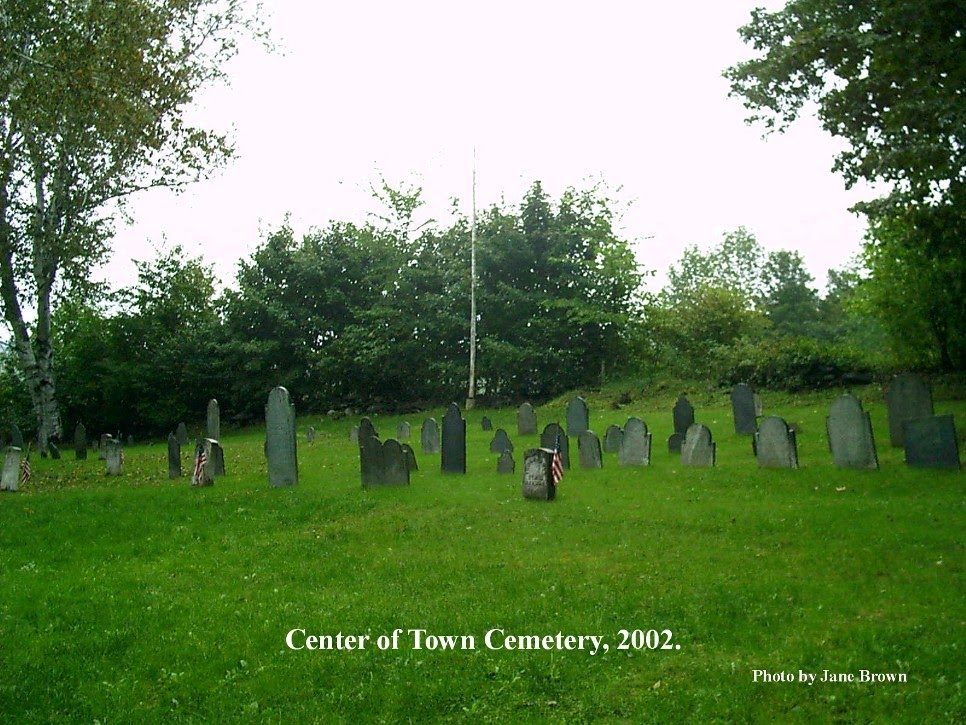
Center of Town (1799–1846)
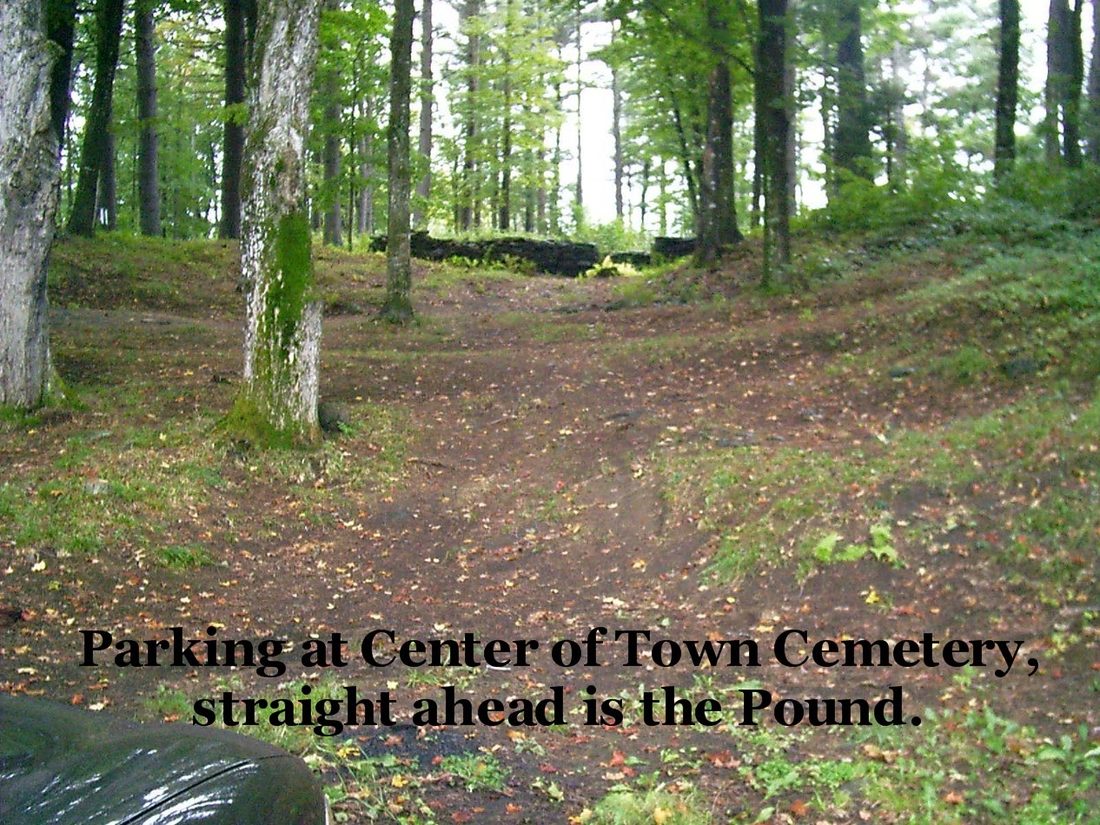
Cabot's oldest burying ground sits on a one-acre parcel given by William Osgood, with eighty-four known burials before it closed in 1846. Osgood himself was the first laid to rest here, in 1801, followed by Squire James Morse — the town's first Justice of the Peace — in 1812, and Cabot's first schoolteacher, Joseph Smith, in 1814. Fifield Lyford, a veteran of both the Revolution and the War of 1812, was the last person buried here. The site is reached by trail off Old Center Road, near the site of the first meeting house and pound.
Durant Cemetery, Lower Cabot (1813)
On the banks of the Winooski River off Route 215, Durant Cemetery began with quarter-acre gifts from Elihu Coburn and Colonel John Stone, with more land added by John T. Durant in 1894. Its beloved Sunken Garden, created by Jennie (Gould) and B. L. "Budd" Bruce with their neighbors, was dedicated in 1931, restored and rededicated in 1993, and marked with a plaque in 2003. It remains in use.
Kimball Cemetery (1814, moved)
A small burying lot of nineteen graves was opened in 1814 on the Kimball farm off what is now Churchill Road. The graves were later moved about a mile west to the West Hill Cemetery, and nothing remains at the original site.
West Hill (1817)
Given by David Lyford and John Edgerton, the West Hill burying ground was laid out in 1817 during a season old-timers remembered as "the great sickness." Edgerton, reciting the old epitaph — "Yet living men come view the ground where you must shortly lie" — became its first burial. It is still used, high on West Hill opposite Dunstable Farm and near the restored one-room schoolhouse.
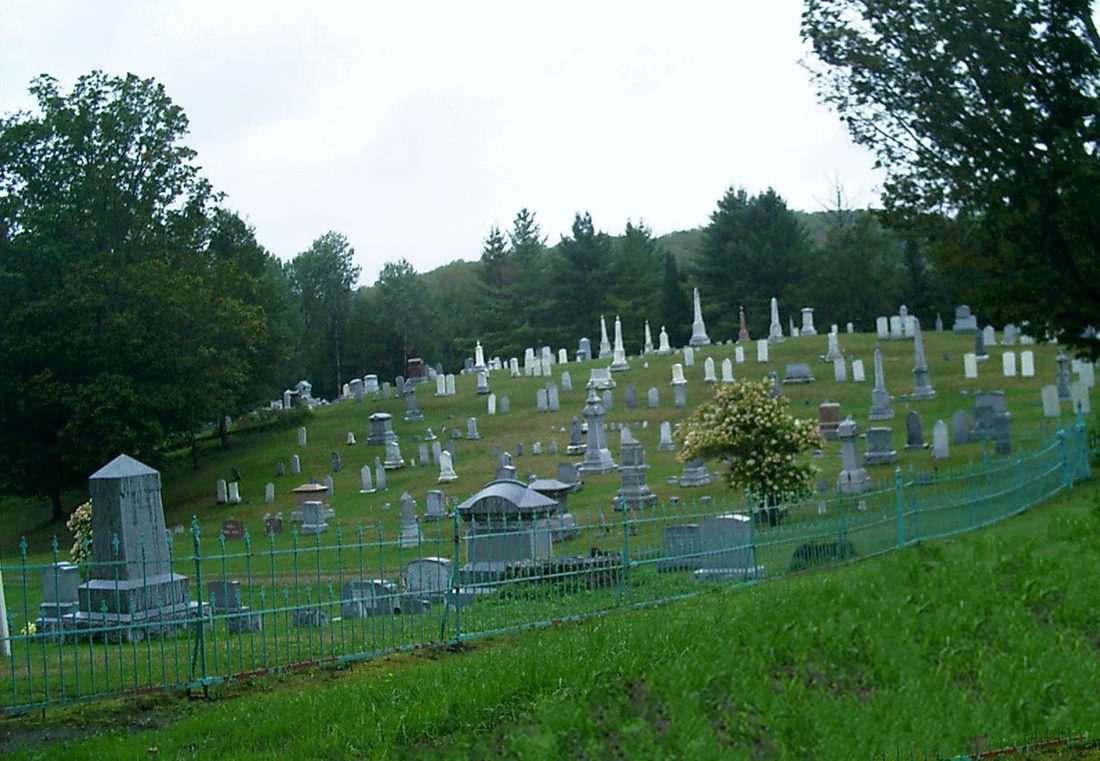
Village Cemetery (1820)
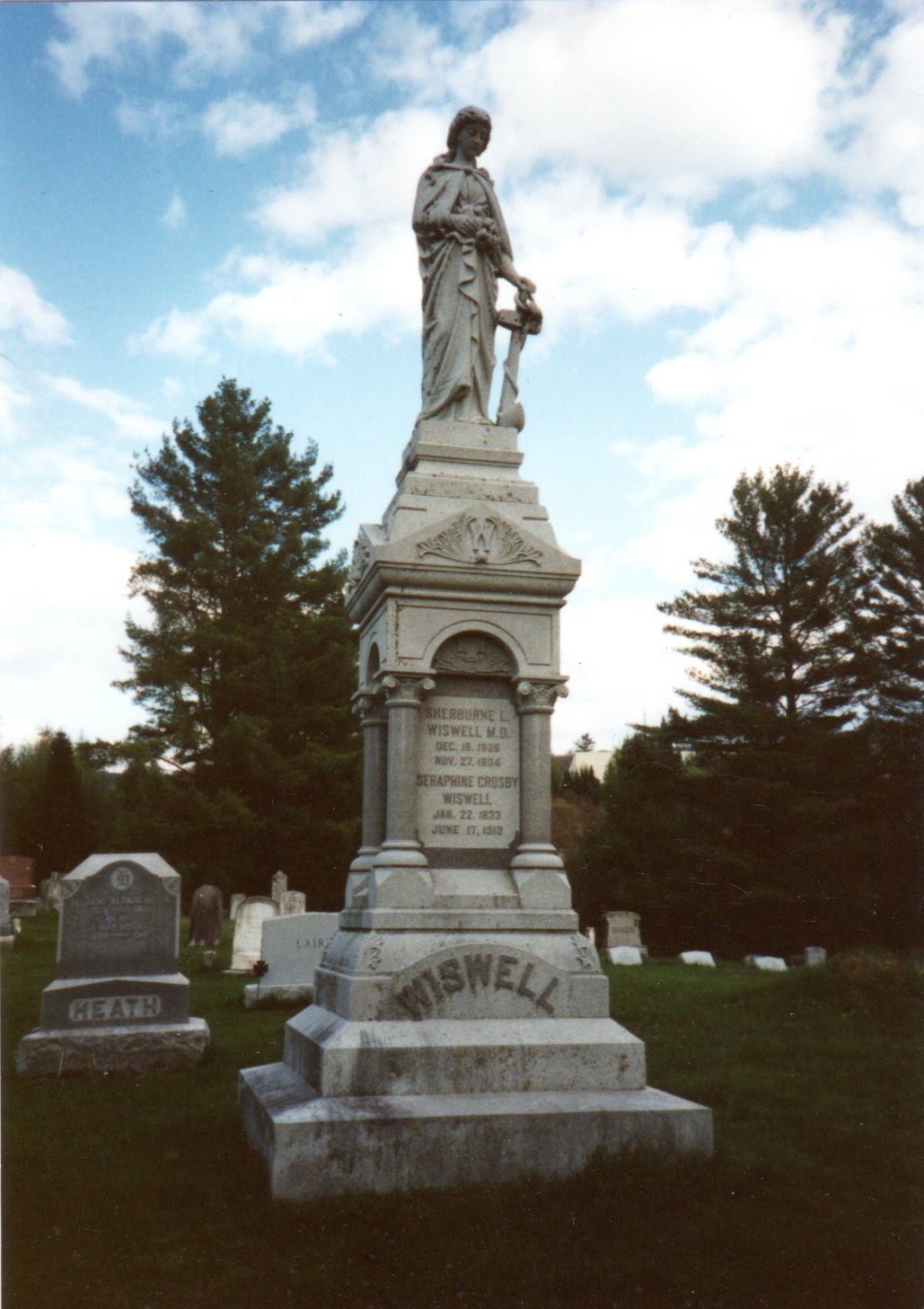
Just off Elm Street near the Cabot Creamery, the Village Cemetery began on a half-acre from John W. Dana and grew as adjoining parcels were added in 1865 and 1905 (the latter a former apple orchard). It has a graceful iron fence, a fountain donated by E. W. Paige, and an old vault. Its most striking marker belongs to Seraphine Crosby Wiswell, wife of Dr. Sherburne L. Wiswell, who declared she would have the largest monument in the cemetery — and ordered one so massive it reportedly took seven horses to haul from the stone sheds of Barre.
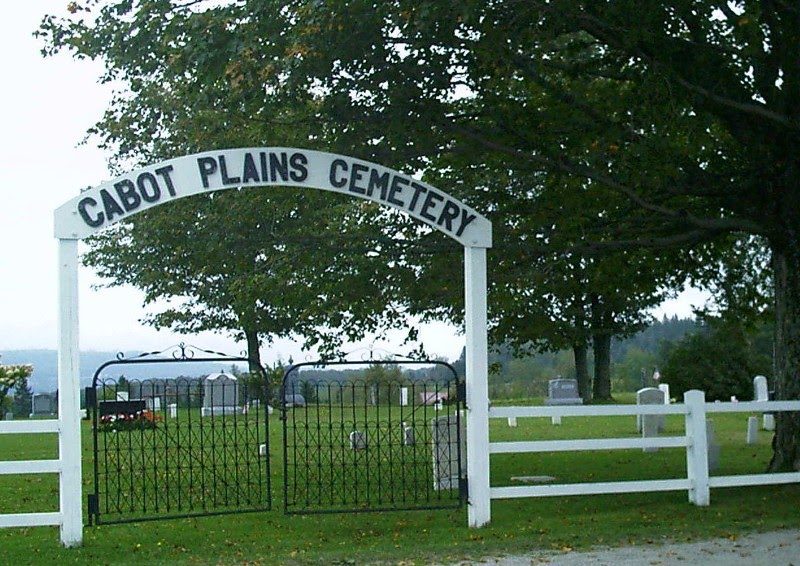
Plains Cemetery (1825)
High on the Bayley-Hazen Road, across from Foster's Covered Bridge, the Plains Cemetery was established in 1825 on land from Alpheus Bartlett, with more added later by Richard Spaulding. A few Covell family stones predate it — Lois Covell died in 1822 — and Alvira Covell is recorded as the first buried, though her grave is unmarked. The cemetery commands a spectacular panorama: Camel's Hump, Mount Mansfield, and the Worcester Range to the west, Jay Peak to the north, and the White Mountains of New Hampshire to the east.
South Cabot (1834)
Off Houghton Road near Goodrich's Maple Farm, this small cemetery was given by Moses Clark, whose six-month-old son Reuben was the first buried here in 1834. Moses himself was laid to rest in 1889, having outlived three wives, all buried alongside him. It remains in use.
East Cabot (1847)
The town's newest burying ground, off Mack Mountain Road near Molly's Pond, was given by George Rogers in 1847, with two small parcels added in 1899 and 1911. Like most of Cabot's cemeteries, it is small and still in use.
The original source pages
These summaries draw on the Society's earlier archive. Each page below is reproduced in full, with its original photographs, maps, and documents.
- Death in Early Cabot
- Epitaphs
- Durant Cemetery
- Dedication of Sunken Garden
- Village Cemetery Map
- Center Cemetery Map
- Durant Cemetery Map
- East Cabot Cemetery Map
- South Cemetery Map
- PlainS Cemetery Map
The Society holds plot maps and burial records for each cemetery, and many names can also be searched online through Find a Grave. For help locating a grave, researching a family, or finding directions, please contact the Society or the Cabot town offices in the Willey Building.