← Back to Resources & Archives
It has been said that a person could live in Cabot for seventy-five years, and belong to four different counties, without ever leaving home. The town has been part of Cumberland, Orange, and Caledonia counties in turn, and — since 1855 — Washington County. Its beginnings lie in the years just after the Revolution, when Vermont was still an independent republic and the north country was raw wilderness.
A Charter, 1781
Cabot was granted on November 6, 1780, and chartered by the Republic of Vermont on August 17, 1781, to Jesse Leavenworth and sixty-five associates. Contrary to a common belief, the land was not payment for military service: buyers paid hard money, which went into the treasury of the cash-strapped little republic. Vermont badly needed it — the Continental Congress covered none of Vermont's war expenses, since she was neither an old colony nor yet a recognized independent state.
How Cabot Got Its Name
Cabot is said to be the only town in Vermont named out of a romance. The beloved version goes like this: Major Lyman Hitchcock of Connecticut and Miss Sophia Cabot fell in love while Lyman was in the Continental Army, but Sophia's father refused to let her marry a soldier. Lyman bought into a Vermont grant — the second-largest purchase in the new town — and when Sophia's father traveled north to appraise the land, he liked what he saw, gave his blessing, and the other grantees agreed to let Lyman name the town for his bride-to-be.
The true story, uncovered by a descendant and the Society's researchers, is more of a saga than a fairy tale. Sophia Cabot was not related to the explorer Sebastian Cabot, and her father — the Reverend Marston Cabot, a Harvard-educated minister who died in his Connecticut pulpit "of apoplexy" in 1756 — had been dead thirty years by the time of the grant. It was more likely her brother, the surveyor Marston Cabot, Jr., who had a hand in the town's naming and in steering Major Hitchcock to buy land here. Lyman and Sophia married in 1785, a year before the lots were even drawn; Sophia herself held lot two, near the Bayley-Hazen Road, worth more than Lyman's single lot on the far side of town. The couple later settled in New York, raising a family through "war, peace, love, and loss." (The Society's archives hold the full account.)
Surveyed & Lotted, 1786
Though chartered in 1781, Cabot was not surveyed and lotted until 1786. The work was led by James Whitelaw — soon to become the Republic's Surveyor-General — together with the surveyor Cabot of Connecticut. Eighteen-year-old Thomas Lyford, whose father was among the first settlers, worked the whole survey. In the far west of the town, so the story goes, Mr. Cabot broke the glass of his compass and had to walk six miles through the wilderness to the nearest house, where he took a square of glass from a window to repair it. The town was divided into seventy-two lots of about 53 acres each, across six divisions.
First Settlers, First Officers
Benjamin Webster — an uncle of Daniel Webster — made the first clearing in 1783 (his family's snowbound arrival is told under Facts & Fables). Most of the original lot owners, however, never lived here; they were speculators who subdivided and resold. Those who stayed built their first settlement on the high, open land of Cabot Plain. The first town meeting was held there on February 4, 1788, and Cabot elected its first full slate of officers in 1793.
Cabot began very much as an army town: when it was first organized, six of the seven men elected to town office had held Continental Army commissions — the lone exception, a private, was made highway surveyor. Major Lyman Hitchcock himself served as Cabot's first town clerk in 1788, its first Justice of the Peace in 1790, and a delegate to Vermont's 1793 constitutional convention. In 1789, Thomas Lyford and his son built an up-and-down sawmill on the Winooski River alongside what is now Main Street.
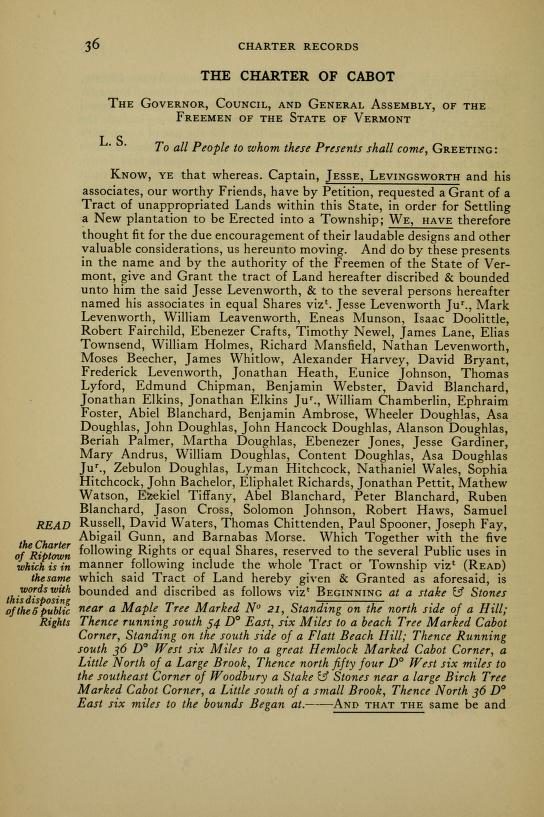
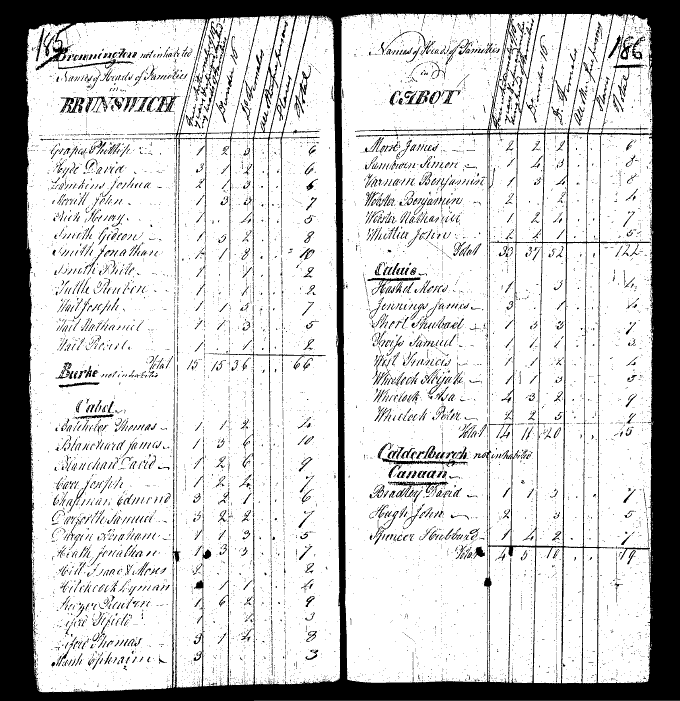
The original source pages
These summaries draw on the Society's earlier archive. Each page below is reproduced in full, with its original photographs, maps, and documents.
- Cabot before 1900
- Timeline
- Jesse Leavenworth
- Year with no Summer
- Naming Cabot
- Lotting by Numbers
- Bayley-Hazen Military Road
- Parcel 141
- 1790 U S Census
- Charter 1781
- Early Town Officers
The Society's collection holds much more on the founding years — the full 1781 charter, the 1790 census, the list of original lot owners, and a town timeline including the "Year Without a Summer" of 1816. To explore these records or research an early family, please contact the Society.