← Back to Resources & Archives
Life in Cabot has always followed the land — the sugar maples on the hillsides, the ponds and rivers that powered its mills, and the long seasonal round of farm work. Nowhere is that rhythm clearer than in the town's oldest and sweetest tradition: making maple sugar.
Maple Sugaring
Cabot's sugaring story begins with the town itself. When Benjamin Webster left his wife at their cabin on Cabot Plain after arriving in deep snow in 1783, Mrs. Webster began tapping maple trees. She made forty pounds of sugar that year, according to John Fisher's 1881 history. For wilderness families, maple sugar was an essential commodity, and the race each spring to gather sap before the trees budded was serious work: it takes at least forty gallons of sap to make a single gallon of syrup.
The techniques came from Native Americans, who taught settlers to tap the trees — early on by cutting V-shaped slashes — and to boil the sap by dropping hot stones into hollowed logs or bark containers. Later settlers held "sugaring parties," camping in the woods for days to boil sap down in a clearing in the sugar bush, carrying buckets on shoulder yokes. Sugarhouses appeared in the 1850s; the first crude evaporator came in 1858, a two-pan model by 1872, and flued evaporators by 1900, each advance shortening the long hours of boiling — though a good run still meant tending the fire all night.
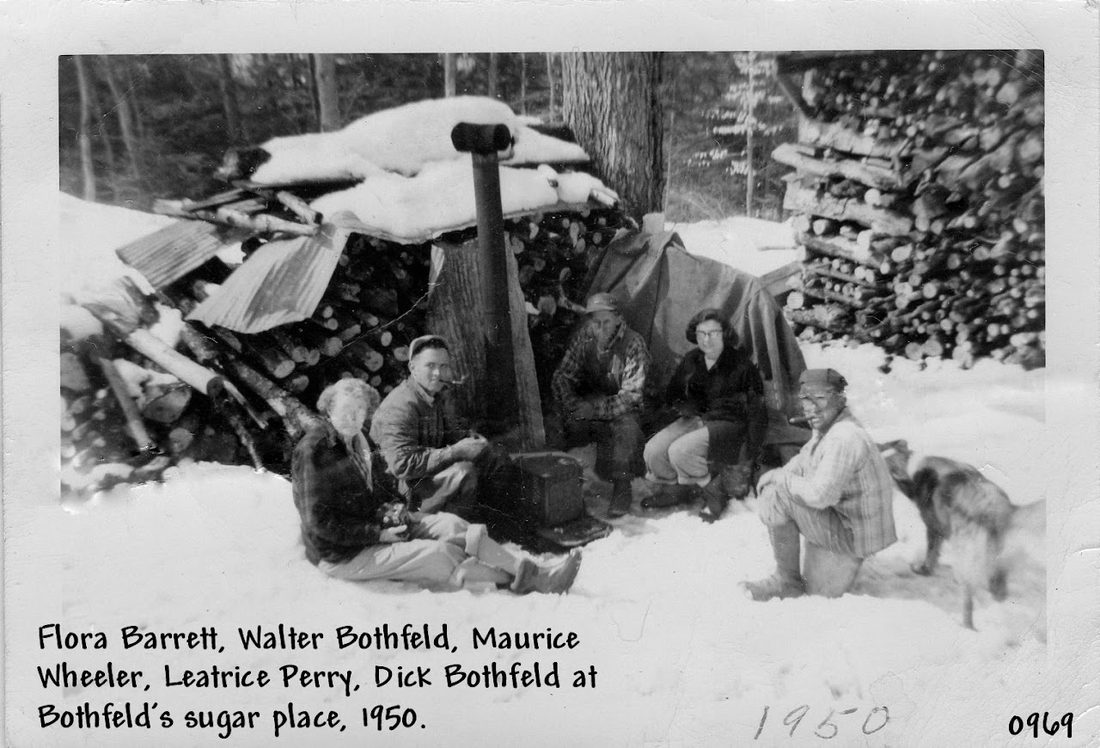
Sugaring runs deep in Cabot's families. Goodrich Farm in East Cabot has made maple products for seven generations since 1840; Inez Abbott, photographed gathering sap around 1910, married Wendell Goodrich, and their descendant Glenn Goodrich went on to invent an efficient evaporator. The Hill family sugared with oxen on their West Hill farm, where young George E. Hill and his widowed mother Lucia carried on after his father's early death. At Maple Glen Farm, Alonzo Foster devised an improved sap spout — fitted with a hook to hold a cover against debris and animals — on land now part of Burtt's Apple Orchard. Sugaring continues today at family operations including Dunstable Farm (the Bothfelds, longtime ox-teamsters), Talbert's Maple Farm, Cabot Hills Maple, Blaisdell's, and Ackermann Maple Farm, many of which welcome visitors during the season.
The price of syrup tells its own history: $1.50 to $2.50 a gallon in the 1930s, a wartime ceiling of $3.39 during World War II, and about $75 a gallon by 2026 — all of it held to Vermont's strict purity standards.
Ponds, Waters & Scenery
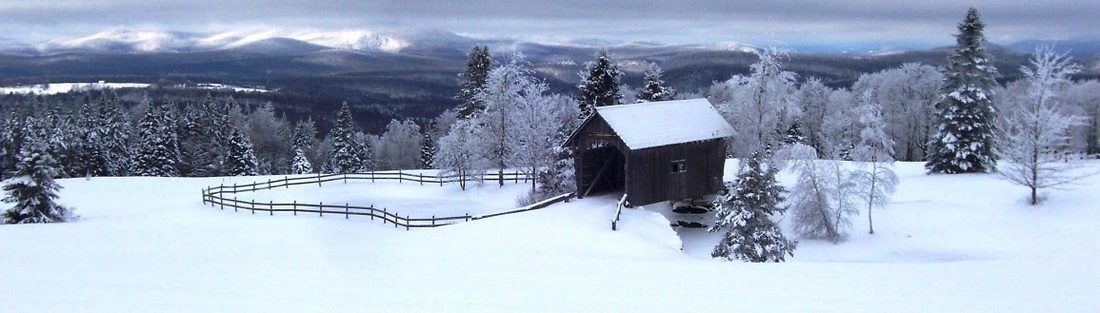
Water shaped Cabot as surely as the maples did. Cabot Plain forms a continental divide. Brooks on the west slope run into the Winooski (once called the Onion) River that has headwaters in the northwestern corner of Cabot; and on the eastern side, water drains into Joe's Pond and the Connecticut River. Little Molly's Pond in East Cabot has brooks running from it in both directions. Molly's Falls Reservoir provides power for generating electricity; Joe's Pond has a long history that includes logging, mills, and recreation; West Hill Pond was once a fertile valley where Native Americans traveling through the area planted crops. The little brook was dammed and became an important resource for power, ice for Cabot Creamery, and recreation. Cabot Plain, Danville Hill, and West Hill have sweeping views from the Green Mountains in the west to the White Mountains in the east.
The Seasonal Round
Everyday life turned with the seasons and the community's gatherings. For twenty years the Society's Apple Pie Festival crowned the autumn, and generations of townswomen kept village life humming through the Judith Lyford Woman's Club, whose fundraising built Willey Memorial Hall and its library. These were the traditions — sugaring, harvest, church suppers, and club bazaars — that bound a scattered hill town together.
The original source pages
These summaries draw on the Society's earlier archive. Each page below is reproduced in full, with its original photographs, maps, and documents.
The Society holds many more photographs of sugaring, the ponds, and Cabot's scenery, along with records of the Judith Lyford Woman's Club and the town's churches. To browse them or share your own, please contact us.