← Back to Resources & Archives
No eighteenth-century structures survive in Cabot — none of the log cabins of the Websters, Lyfords, or Heaths. Along the old Bayley-Hazen Road, stone foundations and cellar holes, now overgrown, mark where the first settlers eked out a living. Five small granite markers on Cabot Plain recall the tavern, the town's first schoolhouse, the Hazen campsite, the Hazen Road, and the spot where first settler Benjamin Webster cleared his land.
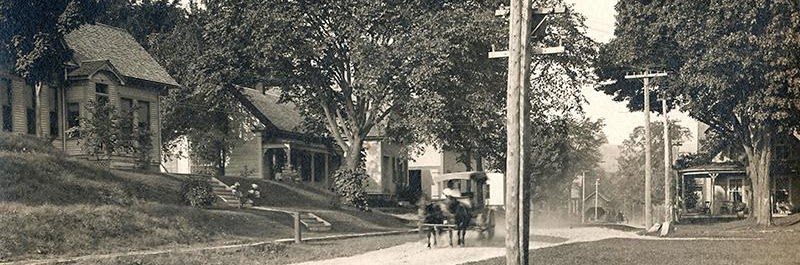
Cabot's government began on the Plains, where former Revolutionary soldiers held the first town meetings in 1788. After about eighteen years it moved to the geographic Center of Town — where only faint foundations, the old Center Cemetery, and the site of the animal pound and whipping post remain — and by 1849 shifted again downhill to the growing Village beside the Winooski River, still the town's center today. As sawmills rose along the river and roads improved, more substantial buildings followed.
Village & Lower Cabot Homes
The Village and Lower Cabot Historic Districts hold many fine examples of nineteenth-century architecture, documented in a 1979 state survey. Among the most notable: the Wiswell house (1886–89), a richly detailed Victorian still owned by fifth-generation Wiswell descendants; the stately Judge Lamson home on Elm Street (1869), little changed, with a sweeping lawn and well-kept carriage houses; and the True A. Town house in Lower Cabot (1875–78), a regionally rare "Carpenter Gothic" once owned by a house painter who specialized in authentic Victorian colors.
Old Schoolhouses
Several of Cabot's one-room schoolhouses still stand (see Cabot Schools). The Lower Cabot Schoolhouse of 1880 — whose bell, once objected to as too noisy, mysteriously vanished and was found years later in a mill pond — is now a private home little changed on the outside. The West Hill Schoolhouse (c. 1896), owned by the Society, has been restored with authentic furnishings as a learning center. The Walbridge Schoolhouse was moved from Route 215 to Cabot Plain and made a vacation home while keeping its original exterior. And the Village School of 1845 — later a Good Templars' hall, then a plumbing shop — is today the Society's Main Street Museum.
Cabot Common & the Churches
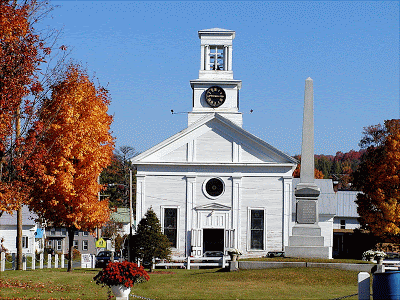
The village green, Cabot Common, holds a granite obelisk to the Union soldiers of Cabot who died in the Civil War, with a small Liberty Tree marker to the American Revolution nearby. Two churches once faced the common. The United Church of Cabot traces to the Congregational Church organized in 1801 at the Center of Town; its building was moved to the common and later enlarged, and remains in use. The Methodist church was built about 1823; as membership dwindled, the two congregations merged in 1935 to form Cabot United Church, and the Methodist building later served as a school gymnasium and classrooms before passing into private hands.
Willey Memorial Hall
Cabot's grandest civic building grew out of the town's need for a library. In 1916, during Old Home Week, former summer resident Charles A. Willey — a Cabot boy who had risen from painting sleighs at the local carriage works to found a New York carriage-paint company — offered two dollars for every one the community could raise. The ladies of the Judith Lyford Woman's Club met the challenge, raising $3,573 in a year; true to his word, Willey added $7,646, and neighbors gave more in money, materials, and labor.
Built in 1920–21 to a design by Montpelier architect Frank A. Walker, with Cabot-milled lumber and a volunteer building committee led by Dr. Lester W. Burbank, the two-story hall now has town offices at the basement level, the library and meeting rooms above, and a 400-seat auditorium with a balcony and stage on the top floor. Willey — who died in 1918 — never saw the building that bears his name. For fifty years it hosted plays, dances, and town meetings while the Woman's Club supported the library through teas, sales, and bazaars. The club deeded the building to the Town of Cabot in 1974, on the condition that the town maintain the library and hall for the benefit of residents. After extensive renovations it remains a center of town life, fully accessible, its third-floor auditorium little changed.
The original source pages
These summaries draw on the Society's earlier archive. Each page below is reproduced in full, with its original photographs, maps, and documents.
The full 1979 historic survey and the Society's building records offer much more detail. To research a particular building or arrange a museum visit, please contact the Society.